


Competition should be the engine of public procurement: more suppliers bidding should mean better prices, better quality, more innovation and greater value for taxpayers. Yet across major procurement systems, the number of suppliers willing to compete appears to be shrinking.
The European Union provides a striking illustration, but the problem is repeated elsewhere. Average participation fell from 5.4 bids per procedure in 2006–2010 to 3.4 in 2017–2024 – a decline of about 37%. Over roughly the same period, the share of procedures attracting only one bid increased from 15.66% to 19.43% – an increase of nearly a quarter. The problem is not universal: contracts worth more than €20 million attracted around 9.2 bids on average in 2017–2024, indicating that the problem is principally a difficulty in attracting suppliers to ordinary/smaller tenders.
 Figure 1. Average bids per EU procurement procedure. Source: European Commission (2025)
This raises a more fundamental question: is the problem really a lack of suppliers willing to participate?
Competition starts before the tender
A tender can be formally open to everyone (often the default starting point in public procurement) and still be weakly competitive.
Explanations for declining competition in public procurement coalesce around three main areas: regulatory complexity, coupled with bureaucratic and cumbersome administrative rules; public buyer weaknesses – inadequate market knowledge, risk aversion reflected in onerous compliance requirements, prohibitive resource requirements, unnecessarily complex, prescriptive or poorly written qualification criteria and specifications; and on the supplier side, a diminishing supplier pool and unwillingness to participate.
The regulatory and many aspects of buyer side have been well-ventilated in the literature, so this piece assumes reforms are ongoing to tackle them and will focus on improving contracting authorities’ market knowledge and suppliers’ willingness to participate.
Suppliers engaging or considering engaging in public procurement have a series of hurdles to overcome: discovering an opportunity, deciding that it is commercially worthwhile, understanding what the buyer wants, establishing that they are eligible and capable, and then investing the time and money needed to prepare a bid.
At each stage, suppliers may decide not to proceed. The contract may be too small or fragmented; the probability of winning may appear too low; the requirements may be unnecessarily demanding; or an incumbent may appear to have an unspoken advantage because it already knows the buyer, the system and the requirements.
That last factor is sometimes under-emphasised. The US Government Accountability Office has identified incumbent advantage and market consolidation (as previously competing bidders consolidate into larger supplier teams) among factors that reduce effective competition. A supplier does not need to be formally excluded to be deterred: if it believes that the incumbent is likely to win, the rational decision may simply be not to bid.
This suggests that procurement policy needs to think about competition as a process, not an event. The key question is not simply, “What formal rules require open competition?” but also, “How many credible suppliers knew about the opportunity, understood it and thought it was worth pursuing?”
From repeated contests to a relationship with the market
Traditional public procurement has largely addressed the risk of favouritism by requiring repeated, discrete competitions. With some exceptions – framework agreements, qualification systems and similar mechanisms – the contracting authority and supplier effectively start from scratch each time.
There is an obvious virtue in this model: it protects contestability. But it also has costs. Buyers repeatedly investigate the market, and suppliers in turn repeatedly incur costs of entering a new procurement process. Continuing relationships with (selected) suppliers could reduce those costs, but could create another danger: greater incumbent advantage, supplier lock-in and a shrinking pool of competing suppliers.
A third way could be a continuing relationship with the market, rather than a continuing relationship with suppliers.
The UK’s Procurement Act 2023 is testing this idea. It creates a more graduated sequence of communication before the formal competition: a Pipeline Notice can provide a forward view of expected procurements; a Preliminary Market Engagement (PME) Notice signals engagement with the market; and a Planned Procurement Notice (PPN) can give advance warning of a particular forthcoming competition. Only then does the Tender Notice formally open the competition.
| Notice | Main purpose | When? | Mandatory? | What does it tell suppliers? |
| Pipeline Notice (UK1) | Give the market a forward view of the authority’s procurement plans | Up to 18 months ahead | Yes, for certain large-spending authorities | “These are the contracts we expect to procure” |
| PME Notice (UK2) | Tell the market about preliminary market engagement | Before/around market engagement and before Tender Notice | Conditional | “We are engaging (or have engaged) the market about this requirement” |
| Planned Procurement Notice (UK3) | Give advance notice of a specific forthcoming competition | Before Tender Notice | Optional | “We intend to launch this particular competition” |
The difference is subtle but important. In a conventional system, the first meaningful signal to many potential suppliers may be the tender itself. The UK model attempts to give the market visibility and an opportunity to engage before the procurement has been fully designed.
Why earlier engagement might matter
Early engagement can address two different barriers to participation.
First, suppliers need time to see an opportunity, assess it and plan capacity. A forward pipeline can make a procurement visible months before the tender is launched.
Second, market engagement can improve the buyer’s understanding of what the market can actually provide. The UK Government’s rationale is that this can help authorities clarify requirements, assess market capacity, shape procurement strategy and identify barriers, including barriers facing SMEs.
There are safeguards. Market engagement must not distort competition or give an individual supplier an unfair advantage. The objective is not to replace competition with a preferred-supplier relationship, but to make the eventual competition more informed and accessible.
The early evidence is encouraging, although it should not be oversold. Open Contracting Partnership analysis of the first year of the Procurement Act found that procedures using a UK2 or UK3 notice attracted an average of 4.7 bids, compared with 3.8 where neither was used—roughly 24% more bids.
OCP also found a notable change over the first year in procurement methods: direct awards fell from 53% in March 2025 to 34% in February 2026, open tendering increased from 27% to 41% and was the majority method in the final two months of the period. By value, excluding cross-government frameworks, 52% of awarded.
This indicates that competition may depend not just on the formal opportunity to bid, but on whether suppliers have sufficient advance information and engagement to develop an interest in bidding. Giving suppliers earlier visibility and engaging them before the procurement is finalised may be one mechanism for reversing weak participation—although we will need several years of data before we can say that with confidence.
OCP highlights that the dataset is only one year old, there are data-quality and interpretation issues, and its figures may differ from official Cabinet Office statistics. The first-year dataset is also too short to separate the effects of the reforms from changes in the composition of procurement or suppliers’ adaptation to the new regime.
Nevertheless, the direction is worth watching.
SMEs: an especially interesting test
The UK’s first-year data contain another potentially important signal. SMEs and VCSEs accounted for 54% of bids in March 2025, rising to 67% in February 2026. Over the same period, the share of lots identified as suitable for SMEs/VCSEs rose from 57% to 72%.
Again, this does not prove that the Procurement Act caused an increase in SME participation. Reporting practices, procurement mix and the introduction of new data fields may all have contributed. But the pattern is consistent with a broader proposition: competition may be improved not merely by removing formal restrictions, but by actively designing procurement so that more suppliers can participate.
The contrast between procurement methods is particularly striking. OCP found that 61% of open tenders and 73% of below-threshold open competitions were awarded to at least one SME, compared with 36% for direct awards. Open competition is therefore not just a procedural concept; it is associated with a broader supplier base.
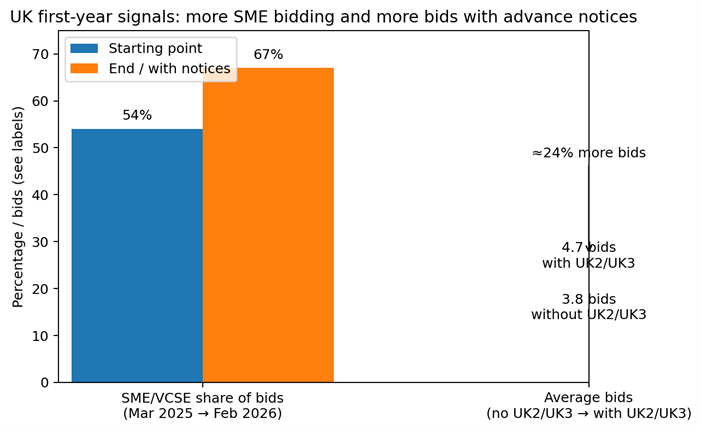
Figure 2. Selected first-year indicators from OCP’s analysis of the UK Procurement Act. Source: underlying draft note / OCP (2026).
Incumbency and the past-performance dilemma
There is another way of building a continuing relationship between government and suppliers: make past performance count.
The US federal system makes past performance a potentially important competitive asset. This can create a powerful incentive to perform well: good performance improves a supplier’s prospects in future competitions. But the same mechanism obviously deters new entrants. A supplier with no government track record may reasonably conclude that it cannot compete on equal terms with an established incumbent.
The UK Procurement Act separates conditions of participation—whether a supplier has the capability to perform—from the evaluation of the tender itself. Past experience can establish capability, but the system does not generally turn a long record of government contracts into an automatic award-stage advantage.
There is a genuine policy trade-off here. Rewarding past performance can encourage investment in government-specific expertise and help buyers identify reliable suppliers. But rewarding it too heavily can make markets less contestable. Conversely, refusing to reward it can protect entry while weakening incentives for suppliers to invest in excellent long-term performance as part of a competitive strategy.
A more promising balance?
A useful distinction is between three different uses of supplier history.
Experience thresholds can exclude new entrants if they are unnecessarily demanding.
Poor-performance criteria can protect government by excluding suppliers that have demonstrated serious inability or unwillingness to perform.
Positive past-performance weighting can give established suppliers an additional competitive advantage.
These mechanisms have very different effects on competition. The UK model shows that a system does not have to choose between trusting incumbents and ignoring supplier history altogether. The official guidance states that conditions of participation assess the supplier itself, while award criteria assess its tender response. So suppliers must demonstrate that they can do this successfully for government and not that they have done so previously.
Identifying and reducing unnecessary barriers also includes lowering the cost of repeatedly supplying core information; and designing procurements so that credible smaller suppliers can participate.
The UK’s Central Digital Platform is intended to contribute by allowing suppliers to register core information once and maintain it, rather than repeatedly submitting the same information. Whether this will deliver its promised reduction in entry costs remains to be seen—the limited success of the EU’s European Single Procurement Document is a useful warning against assuming that digitalisation automatically reduces burden.
Competition is a market-building exercise
The broader lesson is that effective competition cannot be created at the moment a tender is published. It depends on the conditions that exist before the tender: the size and structure of the market, suppliers’ expectations about their chances of winning, the information available to them, the cost of bidding and their perception of incumbent advantage.
The EU evidence suggests that simply requiring competitive procedures has not been enough to prevent participation from declining. The US experience illustrates the opposite risk: making supplier history a valuable competitive asset can strengthen performance incentives while potentially reinforcing incumbency.
The UK reforms are interesting because they attempt to address the problem from another direction. Rather than choosing between a transactional procurement model and a continuing bilateral relationship with incumbents, they seek to build a continuing relationship with the market itself.
The early numbers are encouraging: more open procurement, more SME bidding and, most strikingly, an association between advance market engagement or procurement notices and higher bidder numbers. But one year is not enough to establish that the reforms caused these changes.
The real test will come over the next several years. If the relationship between early market engagement and higher participation persists after controlling for the type, size and attractiveness of procurements, it would provide important evidence that competition can be strengthened by investing in the market before the competition begins.
Perhaps, then, the route to more competition is not simply to make tenders more open. It is to make markets more contestable—by ensuring that more suppliers know about opportunities, believe they can win, understand what is required and can afford to participate.
In public procurement, nearing the competition destination means beginning long before the tender notice is published.
Sources
Sources: European Commission (2025), Evaluation of the Public Procurement Directives and associated studies; European Court of Auditors (2023), Public procurement in the EU: Less competition for contracts awarded for works, goods and services; Fredo Schotanus (2025), “What to do with competition for public contracts in the EU”; US Government Accountability Office (2010), Federal Contracting: Opportunities Exist to Increase Competition and Assess Reasons When Only One Offer Is Received; Kim Loader (2015), “SME suppliers and the challenge of public procurement”; and Open Contracting Partnership (2026), “The UK Procurement Act one year on: what does the data tell us?”
Disclaimer: Statements expressed in this blog reflect the personal opinion of the author and do not represent the position or policy of GBPG or entities we are affiliated with. While we strive to ensure the accuracy of the information presented, we make no guarantees regarding its completeness, reliability, or accuracy.