
Global Aid: Caught in the Crossfire
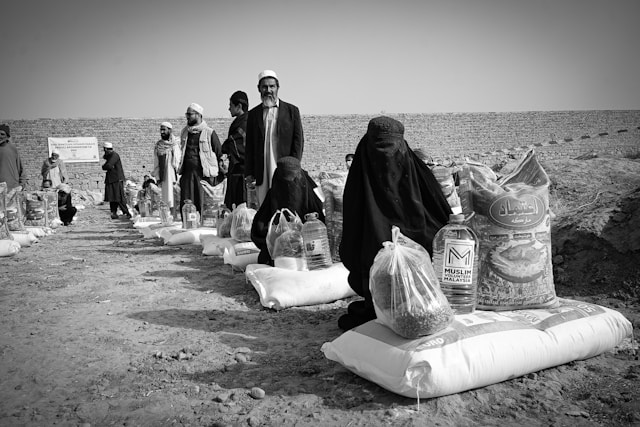
“Extraordinary times require urgent action and new solutions. The Covid-19 pandemic upended decades of development progress that lifted more than one billion people out of poverty. The climate crisis is an existential threat to people and the planet. The international community’s efforts to end poverty and achieve the Sustainable Development Goals by 2030 have fallen off track. People in many parts of the world face widespread hunger, water and energy scarcity, and fragility, conflict, and violence. The international community must rise to meet these needs with urgency.” Report to the Board of Governors, World Bank Development Committee, Sept. 27, 2023 It’s unusual for international aid to be at the center of global news and public debate. Typically, everyday operations of the World Food Program, USAID, the IMF and World Bank, and the World Central Kitchen are buried in the back pages of newspapers, rarely featured on social media, and low on the agendas of the US Congress, and legislative bodies across aid-donor countries. But with major armed conflicts raging in at least three regions, with cross-border refugee flows rapidly rising, and with global trade and investment shifting dramatically due to global Pandemic, “foreign aid” is at the fulcrum of contentious national political controversies in 2024 – all amid widening skepticism both about globalization itself, and growing interdependency of nations worldwide. Indeed, flows of international aid approached near-record levels in 2022, exceeding $200 billion in new commitments. Russia’s invasion of Ukraine in early-2022 triggered an upsurge of economic and military aid, boosting Ukraine to the top historic ranks of all US aid recipients, alongside Vietnam, Afghanistan, Israel, Egypt, France, United Kingdom and Iraq. Total US aid was about $70 billion in 2022, and Ukraine received roughly $12.4 billion, or 18% of total. But the Center for Global Development in D.C. recently revealed a startling fact: US aid to “low-income” countries (LICs) has steadily decreased during the past decade (2012 to 2022). This aligns with a recent OECD analysis that found that all aid to LICs and least developed countries (LDCs) had also steadily fallen in 2022. Of course, alongside growing armed conflict, the other key factor affecting global aid flows was the worldwide surge in political and economic refugees, and the essential humanitarian support to displaced people on multiple continents, which rose to 15% of total OECD aid in 2022. Regrettably, the Israel-Hamas war and resulting essential refugee aid support has succumbed to national and global crossfire. Despite the fact that nearly 1.4 million Palestinian refugees rely on the UNWRA for food assistance, in March 2024, the US Congress and Germany both paused all aid to the specialized United Nations agency for one year, pending the outcome of a conflict-related investigation of UNWRA. As UN Secretary General, Antonio Guterres sadly observed at the time of these cuts, “UNWRA is the backbone of all humanitarian response in Gaza.” A March 2024 analysis of the US Council on Foreign Relations further explains: “UNRWA is the only UN agency that provides direct services to Palestinian refugees; it also employs more than 13,000 people in the enclave alone… UNWRA now serves as the primary provider of shelter, food, water, and employment for many Palestinians. In addition to preventing the risk of famine through its delivery of essential aid, UNWRA provides the mattresses, hygiene kits, blankets, and vaccines for children against childhood diseases such as measles and mumps.” With an operating budget of about $800 million in 2023, UNWRA provided vital financial backing for a network of over 600 schools, 60 refugee camps, and over 200 health facilities for an estimated 5 million-plus Palestinian refugees living in Jordan, Lebanon, Syria, Gaza Strip, and the West Bank. Thanks to the abrupt pause in all aid to UNWRA by the US and Germany, most of this essential humanitarian support has been halted across the ME Region. The current prospect is far-reaching famine across most parts of the GAZA – with no resolution for these desperate people end in sight! Regional wars and refugee flows are increasingly competing for international aid finances, and the poorest developing countries are feeling the most economic and physical pain. According to the World Bank, food price inflation greater than 5% has badly hit over 60% of all LICs, and 64% of all lower-middle income countries. Moreover, the “State of Food Security and Nutrition in the World 2023” assembled by FAO, UNICEF, World Food Program and WHO confirmed that global hunger remains far above pre-Pandemic levels — almost 800 million people faced serious hunger in 2022, roughly 122 million more than before the global Covid-19 wave. The “Global Hunger Index 2023” confirmed this trend, projecting that over 600 million people in 43 countries – stretching from Central Africa to the burgeoning slums of South Asia — will be chronically malnourished by 2030, Among the world’s leading development economists, there’s a growing recognition that the recipe for national economic advancement through large-scale industrialization pioneered by the “Asian Tigers” – Hong Kong, Singapore, China, Taiwan and South Korea – simply can’t be replicated by most poor developing nations. As Patricia Cohen of the New York Times observed: “The Asian Tigers and China succeeded by combining vast pools of cheap labor with access to international know-how and financing and buyers that stretched from Kalamazoo and Kuala Lumpur. Governments built up the roads and schools, offered business-friendly rules and incentives, developed capable administrative institutions and nurtured incipient industries.” But the 21st Century economic circumstances have markedly changed: information technology is rapidly advancing and displacing workers; global supply chains are dramatically shifting; growing political tensions are reshaping trade patterns; and poverty, hunger and desperation are rising in the world’s poorest regions. With growing doubts about whether industrialization can still deliver the “miracle growth” it once did, the Times concludes: “For developing countries, which contain 85 percent of the globe’s population – 6.8 billion people – the implications are profound. And very destabilizing as well, I might add! Responding to this fundamentally ‘changing landscape’ for developing nations, the
