
Rethinking Education: Blending Tradition and Technology for a New Learning Era
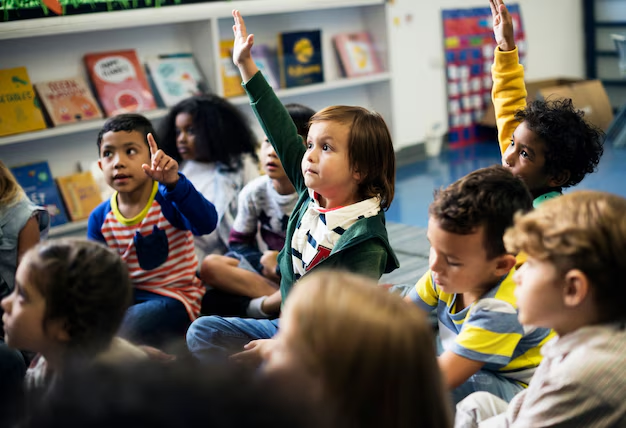
At GBPG, we hold firmly to the belief that true development depends on constant innovation — whether in governance, procurement, infrastructure, or education. Education, in particular, is not only a sector in its own right but also the foundation upon which every other form of development is built. How societies educate their next generation is one of the clearest indicators of their resilience, adaptability, and long-term prosperity. In this post, Gareth Newman, GBPG Advisor on Education, reflects on the challenges facing schools and the opportunities that lie ahead. His insights draw on his first-hand experience as a life-long educator. The Challenge: Are Schools Becoming Outdated? The past two decades have witnessed a profound shift in how knowledge is accessed, shared, and applied. Technology has opened doors that, a generation ago, could scarcely be imagined. Today, young people master new concepts through digital platforms with a fluency that often surpasses the expectations of parents and teachers alike. Yet, despite these societal shifts, many schools continue to resemble their 20th-century counterparts. The physical layout of classrooms remains strikingly traditional, with desks arranged in neat rows facing a teacher at the front. While group work and collaboration are celebrated in theory, the structures of many schools are still designed around individual, teacher-led instruction. Against this backdrop, online learning platforms have surged ahead. They offer structured, interactive, step-by-step learning, accessible anywhere in the world. They provide virtually unlimited resources, often at lower cost and with greater flexibility. This reality forces us to ask an uncomfortable but vital question: Is the traditional school model, in its current form, still the most effective way to prepare young learners for the demands of the modern world? What Cannot Be Replaced It would be misleading, however, to suggest that schools can be replaced entirely by digital learning. The value of a school environment lies not only in academic instruction but in the holistic experiences it fosters. Schools provide: Sport and physical health, which nurture discipline, teamwork, and resilience. Creativity and the arts, where learners are encouraged to experiment, express themselves, and cultivate talents that cannot be measured by exams alone. Face-to-face social interaction, which builds confidence, empathy, and interpersonal skills essential for adulthood. And yet, even this space is evolving. Social development is no longer confined to the playground or the classroom. Young people today form friendships and communities across continents through gaming platforms and social media — interactions unimaginable to their parents’ generation. Still, the structured, in-person experiences that schools offer — drama productions, residential trips, team sports — remain essential pillars of a balanced education. A New Model for Secondary Education For me schools are at the sharpest edge of this transformation. The traditional model of adolescence spent largely within the walls of a school building is being disrupted. I envision a new approach, one that combines the strengths of traditional schooling with the flexibility and dynamism of digital innovation. Such a model could include: Home-based or community-based learning, supported by high-quality, purposedly developed digital applications. Resource hubs located in repurposed school buildings, where learners can access specialist equipment, supervised study spaces, and tutoring support. Small peer learning groups, working together virtually to complete projects, thereby gaining both subject knowledge and collaborative skills. Supervising tutors and technicians, whose role is not to deliver every lesson but to guide, support, and monitor learning progress. Even the structure of examinations could be transformed. Rather than relying solely on high-stakes testing, robust digital platforms may track learning progress in real time, verifying mastery of concepts in ways that are transparent, rigorous, and perhaps less stressful for learners. Innovation as a Responsibility Standing still is not an option. Schools today may be successful in their current form, but the growing appeal of flexible, lower-cost, technology-enabled models of education is undeniable. Families are seeking alternatives that fit their circumstances and reflect the realities of modern life. Governments, meanwhile, are under pressure to contain costs while ensuring equitable access and maintaining standards. The opportunity lies in blending the irreplaceable strengths of traditional schooling with the new possibilities created by digital innovation. This is not a question of replacement, but of integration. The task is to retain what matters — community, creativity, personal development — while using technology to make learning more personalised, accessible, and effective. The Bigger Picture Education does not stand apart from broader global trends. Just as development, governance, and institutional management are being redefined, so too is schooling. Teachers’ roles are shifting from knowledge-delivery to facilitation and mentoring. Physical school buildings may no longer serve as the sole centres of learning, but rather as hubs within broader ecosystems. The balance between academic instruction and personal development is being recalibrated. The responsibility for those of us engaged in shaping education systems is clear: to anticipate these changes, to innovate with care, and to safeguard the values that make education meaningful. As a lifelong educator I see the future of education not as a choice between tradition and technology. It is about finding the right blend — creating models that prepare young people not just for examinations, but for life in a world that is more interconnected, fast-moving, and complex than ever before. Disclaimer: Statements expressed in this blog reflect the personal opinion of the author and do not represent the position or policy of GBPG or entities we are affiliated with. While we strive to ensure the accuracy of the information presented, we make no guarantees regarding its completeness, reliability, or accuracy.
