
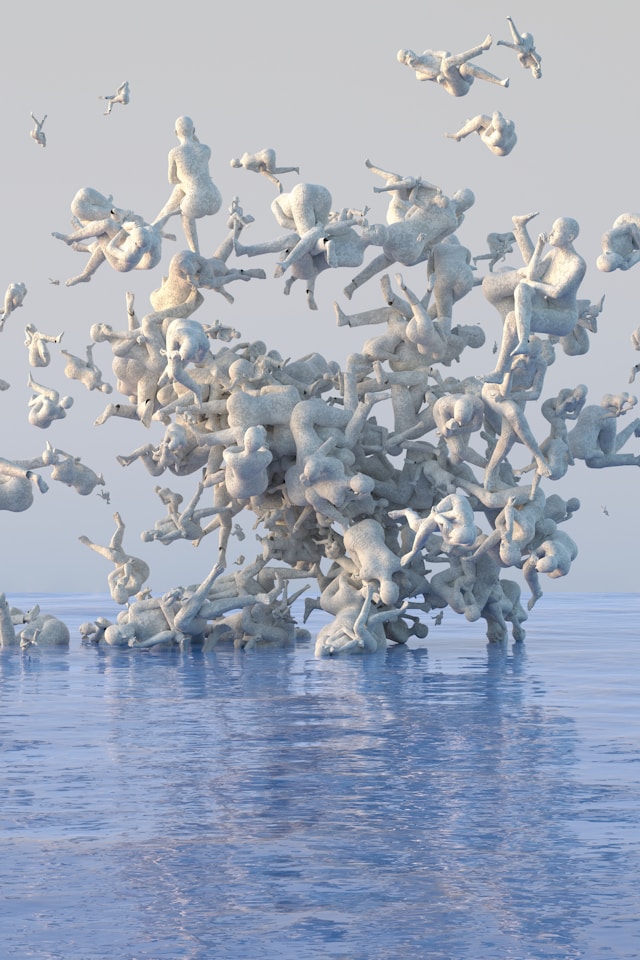

The Comfort of Predictability vs the Inevitability of Change
Security in our everyday lives is founded on predictability. As a species we are comfortable when the parameters of our lives change only slowly and smoothly. Many people are naturally intimidated by change and feel uneasy when faced with it, but if we look back in time, we see that change has been present for the whole of our lives. One example that applies to us all as individuals is that of aging. In general, we reluctantly accept that we are prone to aging, although nowadays there is a vast industry that attempts to convince us that we can somehow cheat it. The results are not always edifying. Aging gracefully, or in some cases aging disgracefully, is a choice. However, when we encounter change we have either to embrace it and adapt to it, or else we will “sink like a stone”, as Bob Dylan sang.
Darwinian evolution is one example of change, which has proceeded over millions of years and to the many thousands of species roaming our earth. Smooth evolution by successive small mutations, often favoured by positive adaptation to environmental changes – food supply, climate, predators – is the reason why we find ourselves where we are today. Occasionally however, smoothness and predictability are disrupted when least expected, and to such an extent that worlds are turned upside down. So it was, 66 million years ago when an asteroid about 12 km in diameter penetrated the Earth’s atmosphere and made landfall on the Yukatan Peninsula on the Gulf of Mexico (I am sufficiently bold to continue to use the name that I learned more than 70 years ago), at a place called Chicxulub. Apart from the subsequent tsunami, huge quantities of fine dust, rich in iridium, were shot up into the atmosphere after the collision, eventually circling the whole planet and reducing the power of the Sun. Temperatures dropped catastrophically and three quarters of the creatures on earth were wiped out in a matter of months, including the dinosaurs. A catastrophe for the ecosystem of the earth!
Learning from Chaos and Catastrophe Theory
But what of the word catastrophe itself? In everyday parlance its meaning is clear, but frankly it has become so overused as to lose its impact. “What a catastrophe!” we often hear. If someone makes a poor presentation they might say – harshly! – to themselves afterwards that it was such a catastrophe. In reality, if we were able to stand back, we would see it as a learning experience. Let’s consider the recent election in the USA and its consequences, real or imaginary. It has attracted global attention in a way that no other election in living memory has, and it continues to keep people on the edge of their seats; many have called it a catastrophe. We are beginning to understand quite what that means, and many people at the individual, societal, national and international levels are wrestling with existential questions that did not exist a couple of months ago, none more so than the global aid agencies that have had the rug pulled from under their feet. How will the world respond, and how can the GBPG react?
Well, let’s turn to physics. There are a number of mathematical theories that deal with unpredictability. Chaos Theory is one of them, which is applied to weather forecasting and the spectacular murmurations of starlings. Another is Catastrophe Theory, developed in the 1970s in order to try and understand deviations from smoothness and what are called singularities in physics. The Big Bang was a singularity, as is a black hole. But let’s start with an elastic band. Stretch it reasonably and it will return to its original shape. Plastic materials behave differently and are permanently transfigured. We are talking here about stress and strain. As we increase the stress on something, for example by bending a metal fork, it will create a strain. The fork will yield. Up to a certain point, when we release the stress the fork will return to its initial shape. But beyond this “certain point” the fork will have been bent too much, and on release will not return to its initial state. This point is known as the elastic limit. We all learned about this in high school science classes. It’s illustrated in the diagram.

Catastrophe theory however goes one step further. The curve in the figure will fold over on itself and then recovers, much like a rug might. So, what happens when we get close to the cusp? Let’s think about the Eiffel Tower on a calm day. The tower is completely steady, but if the wind increases it will begin to flex. The stronger the wind, the greater the flexing. We also see this with airplane wings, which are designed to flex much more than the Eiffel Tower; several metres in fact. As the wind drops the tower will return to its original position. This is equivalent to going gradually up the curve shown in the drawing, and then back again to zero. The Eiffel Tower is designed to sway at the top. Rather scary you might think, but if you were up there you would never notice. Let’s imagine however a wind of such strength that it flexes the tower beyond its elastic limit. It will never return to its original position. If the wind increases further the tower would go beyond the mechanical strength of the steel that it is constructed with, and it will collapse. This is the catastrophe that occurs when you reach the cusp on the drawing and immediately drop to the lower curve – as shown by the dashed line – and cannot return to the original equilibrium curve easily. This reasoning extends to provoking dogs and to interpersonal relationships, where pushing up to the cusp and perhaps beyond will result in a consequence that you did not expect and almost certainly did not want. The dog will bite you and will remain enraged, or your partner won’t speak to you for two days. It was the straw that broke the camel’s back!
Are we heading towards the Elastic Limit?
There are many such applications of catastrophe theory, but let’s think for a moment how it might apply to the current political climate. Let’s say, for want of argument, that some unwise self-absorbed and perhaps overconfident leader should embark upon policies that stress the population or neighbouring countries unreasonably. Strains begin to show, but still at a safe distance from the cusp. Going too close to this point however could be catastrophic. All that would be needed would be a relatively trivial happening. The assassination of Archduke Franz Ferdinand in 1914 comes to mind. Dogs, partners, towers, bridges and whole populations can react unpredictably… There are many examples of this in past history, one famous example being the French Revolution, a later one being the Russian Revolution, and then the start of the first World War. At what point would a current-day Marie Antoinette, dismissively saying “Let them eat cake”, translate into action that spills catastrophically over the cusp onto the curve below, and immediately becomes irretrievable? A wise leader knows to keep well away from such eventualities, but as a society are we heading perilously close to the cusp today? People have their limits. And how do we avoid it happening, or is this one way to resolve the situation? Let us hope not.
Disclaimer: Statements expressed in this blog reflect the personal opinion of the author and do not represent the position or policy of GBPG or entities we are affiliated with. While we strive to ensure the accuracy of the information presented, we make no guarantees regarding its completeness, reliability, or accuracy.
