


I was about to board my flight to Greece when I received a text message from GBPG’s geopolitical advisor, Jason Blazakis. He asked me a simple question: what was I planning to write about for my Midsummer blog?
As I settled into my seat on the plane, I looked down at the book in my hand, FinTech Wars by James da Costa. It struck me how much the development sector could learn from the fintech world: lean structures, rapid execution, performance-driven delivery, innovation, and the ability to adapt quickly to changing environments. The fintech sector succeeds because it is forced to focus relentlessly on results, efficiency, and implementation. Too often, the development sector does the opposite.
That led me to think about the biggest hurdle preventing meaningful reform. In many respects, the answer is structural. It would be transformative if the United Nations system and the multilateral development banks provided scaffolding for capable SMEs and specialist firms to perform at scale, particularly in implementation and advisory services. There is an enormous pool of agile, technically competent organizations outside the traditional industrial development complex and the legacy aid architecture shaped by large institutional contractors and the old USAID ecosystem. The landscape is changing rapidly, but many systems have not changed with it.
This is where firms such as Global Best Practice Group can rise to the challenge. Organizations like GBPG are designed to be agile, technically specialized, delivery-focused, and capable of operating across complex governance, procurement, infrastructure, financial management, and institutional reform environments. The future of development delivery will increasingly depend on firms that can combine deep technical expertise with speed, adaptability, and practical implementation capacity rather than simply scale and bureaucracy.
The second issue weighing heavily on my mind was procurement integrity and delivery accountability. When donor funds are transferred to recipient institutions, do donors truly know whether procurement processes are being conducted correctly? Do they know where the contracts are going, who is receiving them, and whether the work is being awarded to the most capable organizations? These are not abstract governance questions. They sit at the heart of development effectiveness.
In that respect, the concerns raised by the Secretary of the Treasury of the United States Scott Bessent are valid: where are the contracts going, who is benefiting, and are the best firms being selected? These questions are uncomfortable, but unavoidable.
As the aircraft lifted into the sky over Europe, it became increasingly clear to me that these two issues, creating genuine space for agile SMEs and ensuring transparent and accountable procurement, represent the chasm standing directly in front of the development sector. Until they are addressed seriously, it will remain extraordinarily difficult for the sector to become truly performance-driven, delivery-focused, and capable of meeting the demands of a rapidly changing global environment.
The international development sector has been living through its most disruptive moment since the end of the Cold War. In the space of barely twelve months, the financial architecture that has underpinned global aid delivery for decades has been fundamentally weakened, not through gradual reform, but through abrupt political decisions that allowed for no proper planning, no orderly prioritization, and no managed transition. It created a vortex of chaos but through this can there be an opportunity?
The numbers are stark. The United States, which funded roughly 47% of the global humanitarian appeal in 2024, effectively dismantled USAID in 2025, cancelling 83% of its programs, terminating over 5,300 contracts worth $75.9 billion, and ceasing operations entirely by July 2025. Global humanitarian funding plummeted from approximately $24 billion in 2025 to around €11.7 billion in 2026, according to the UN Financial Tracking Service. The OECD estimates an overall decline in overseas development assistance in 2025 of between 9% and 17%, with health funding potentially dropping by up to 60% from its 2022 peak. The Lancet projects that if current trends continue, the aid cuts could result in 9.4 million additional deaths by 2030.
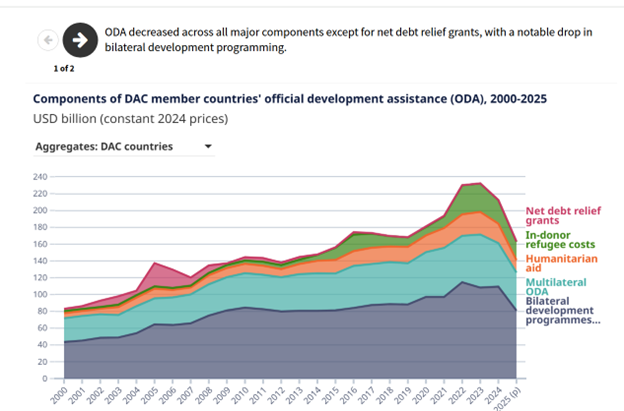
Source: OECD, 2026.
And the United States is not alone. The United Kingdom is reducing its aid budget to 0.3% of GNI by 2027/28, the lowest level since the 1997 to 1999 period,[1] with cuts expected to reach £6.5 billion annually by 2027/28. Germany and Canada have announced their own reductions. The OECD’s preliminary 2025 data has confirmed the sharpest single-year decline in official development assistance in the modern era.[2] Across the 31 UN agencies impacted by U.S. withdrawal, the funding loss has been sudden, severe, and in many cases existential.
A Moment to Reform, Squandered?
There has long been a broad consensus that the international development system needed reform to seize the moment and make things work. The UN’s own Secretary-General launched UN80 as a reform initiative. Taxpayers in donor countries have grown increasingly skeptical about value for money. The perception is, not entirely without foundation, that too much aid is absorbed by institutional overhead or to support underperformance rather than reaching those who need it. And, frankly, this has been shaping political decision-making for years.
As such, the criticism, in part, is justified. Parts of the UN system operate with long-term or repeatedly renewed contracts, waiting for the monthly salary and benefits that are not meaningfully linked to performance, with many immensely talented individuals shackled. by politics and bureaucracy. You can, it seems, tread water for years in ways that would be impossible in the private sector, where you must demonstrate results and generate returns. Whether that comparison is fully fair or not, it is increasingly shaping public sentiment in donor countries, and it is shaping the political decisions that flow from that sentiment.
But what has happened is not reform. It is demolition. What is worse, there was no blueprint for genuine reform in the first place. The UN80 process, which should have been an opportunity to drive efficiency and accountability, has been overcome by the fiscal crisis and is now focused overwhelmingly on cost savings rather than structural improvement. Two decisive key drivers for reform must be to speed up decision-making and to be technology rather than tradition driven. Agile decision-making will require a culture change, while digital transformation will require investment. Instead, the consensus on the need for reform has been hijacked by actors whose interest is in dismantling the system rather than improving it. The result is the worst of both worlds: the system’s weaknesses have been exposed, but the opportunity to address them through thoughtful, evidence-based restructuring has been lost.
Aid Is Geopolitical, and Aid Is Needed
Development aid has never been purely altruistic. It has always been shaped by the strategic interests of donor nations, from Cold War containment to post-9/11 stabilization to migration management. But historically, the multilateral system provided at least a partial counterweight: needs-based allocation, technical standards, and institutional memory that outlasted individual political cycles.
As the UN system loses its financial and operational force, that counterweight is disappearing. What remains will be overwhelmingly geopolitically driven. China has always been explicit about this, the Belt and Road Initiative was never disguised as charity. But the retreat of Western donors from multilateral frameworks means that the field is being ceded to actors whose development engagement is openly transactional, with no pretense of institutional neutrality or needs-based prioritization.
For fragile states and vulnerable populations, this shift is consequential. Aid will increasingly flow to where it serves the donor’s strategic interests, not where the need is greatest. The 239 million people who UNOCHA estimates will need humanitarian support in 2026 will not disappear because the funding has. The needs will persist but now they will simply go unmet, or they will be met by actors whose conditions come with different strings attached.
Can the Private Sector Fill the Gap?
The tide seems to be turning to put some private sector principles into multilaterals action. I note the U.S. Treasury Secretary’s well-intended recent remarks on the future of the IMF and World Bank, significantly focusing on the importance of the private sector and finally mentioning better procurement functions, including contract distribution and more emphasis on quality, and delivery speed as priorities.[3]
In principle, the argument is intuitive. If the public and multilateral systems cannot deliver efficiently, let the private sector step in. The Trump administration has been explicit about this preference, with future U.S. aid expected to be channeled bilaterally rather than through NGOs or multilateral bodies.
In practice, however, most purely private-sector actors lack institutional understanding, the operational ethos, and the on-the-ground experience required to navigate the complexities of multilateral and public-sector environments. Development work is not management consulting with a humanitarian veneer. It requires understanding procurement frameworks that are byzantine by design, operating in environments where the rule of law is contested, managing relationships with sovereign governments that are simultaneously partners and problems, and maintaining the trust of local communities whose cooperation is essential to any program’s success.
The World Bank is taking this issue seriously and is now in the process of improving its competition rates by reviewing and reforming its entire Standard Procurement Documents (SPD) suite to make them more accessible and conducive to private sector participation. GBPG welcomes this and is ready to act on this initiative.
The large contractors, what some have called the “industrial development complex”, can scale, but they often replicate the same overhead and bureaucratic tendencies they were supposedly brought in to replace. Smaller private firms may be more agile, have institutional knowledge, the expertise and the network of relationships that effective delivery in these contexts demands. They are well positioned to enable innovation and change, but who will give them the chance? This is a risk, but it is a measured and worthwhile risk that multilaterals should use strategically to help develop SMEs in coordination with larger entities. SMEs can step up and deliver effectively, but often require guidance, structure, and the right partnerships to build sustainable capability. Positioning yourself as capable and becoming genuinely capable are two different stages of growth, and with the right scaffolding, well-structured contracting, and appropriate support mechanisms, that gap can be successfully bridged to deliver strong and sustainable outcomes.
Trying to Bridge the Chasm
This is where the opportunity lies for organizations that genuinely sit between worlds, that combine institutional knowledge of how the UN, EU, and World Bank systems work with a practical, implementation-focused, results-driven mindset. Organizations whose people have worked inside these systems as practitioners, who understand the procurement processes, the political dynamics, and the operational realities, but who also bring the accountability, pace, and efficiency that the private sector demands.
The Global Best Practice Group was built on precisely this foundation. Our experts come from careers inside the multilateral system. They understand its strengths and its pathologies. They know how to navigate it, and they know where it falls short. That combination of institutional fluency and delivery discipline is rare, and it is exactly what the current moment requires.
The critical question facing the sector is not simply who fills the gap left by retreating donors. It is whether whoever fills it can deliver in a way that is more efficient, more accountable, and more results-driven, without losing the core principles and the hard-won institutional knowledge that underpin effective development work. The answer will not come from the traditional system alone, which has demonstrated its limitations. Nor will it come from private-sector newcomers who lack the experience of operating in these environments. It will come from organizations that can bridge that increasingly large chasm.
What’s Next?
The OECD recently published its preliminary 2025 ODA data. The numbers confirm what the sector already knows: we are in the sharpest contraction of development assistance in a generation. The Better World Campaign’s breakdown of the 31 UN agencies impacted by U.S. withdrawal documents the breadth of the damage. The UK Commons Library’s analysis of global development issues for 2026 lays out the cascading effects across health, education, climate, and conflict.
The sector faces a stark choice. It can spend its energy mourning the old system, or it can adapt to the new reality with clear eyes and practical solutions. Development aid has delivered tangible, measurable benefits over decades: lives saved, diseases prevented, economies stabilized, conflicts mitigated. Those outcomes are real. But the delivery mechanisms must evolve to match the political and fiscal environment they now operate in.
That means smaller, more targeted interventions. It means demonstrable value for money at every stage. It means local ownership and local capacity-building, not dependency. It means working with governments, not around them. And it means organizations that can move at the speed the crisis demands, not at the speed of a UN tender process that, too often, prioritizes process over outcomes.
The need has not disappeared. What has diminished is the collective will and the effective platforms through which funding can be mobilized and deployed. The real question is who now translates analysis into action, strategy into delivery, and good intentions into tangible outcomes for the people who need them most. That is the gap Global Best Practice Group (GBPG) seeks to help fill alongside its partners and stakeholders.
Sources:
[1] https://www.cgdev.org/blog/breaking-down-prime-minister-starmers-aid-cut
[2] https://www.oecd.org/en/data/insights/data-explainers/2026/04/a-historic-decline-in-foreign-aid-preliminary-2025-oda-data.html
[3] https://home.treasury.gov/news/press-releases/sb0442